 Over 150,000 satisfied customers
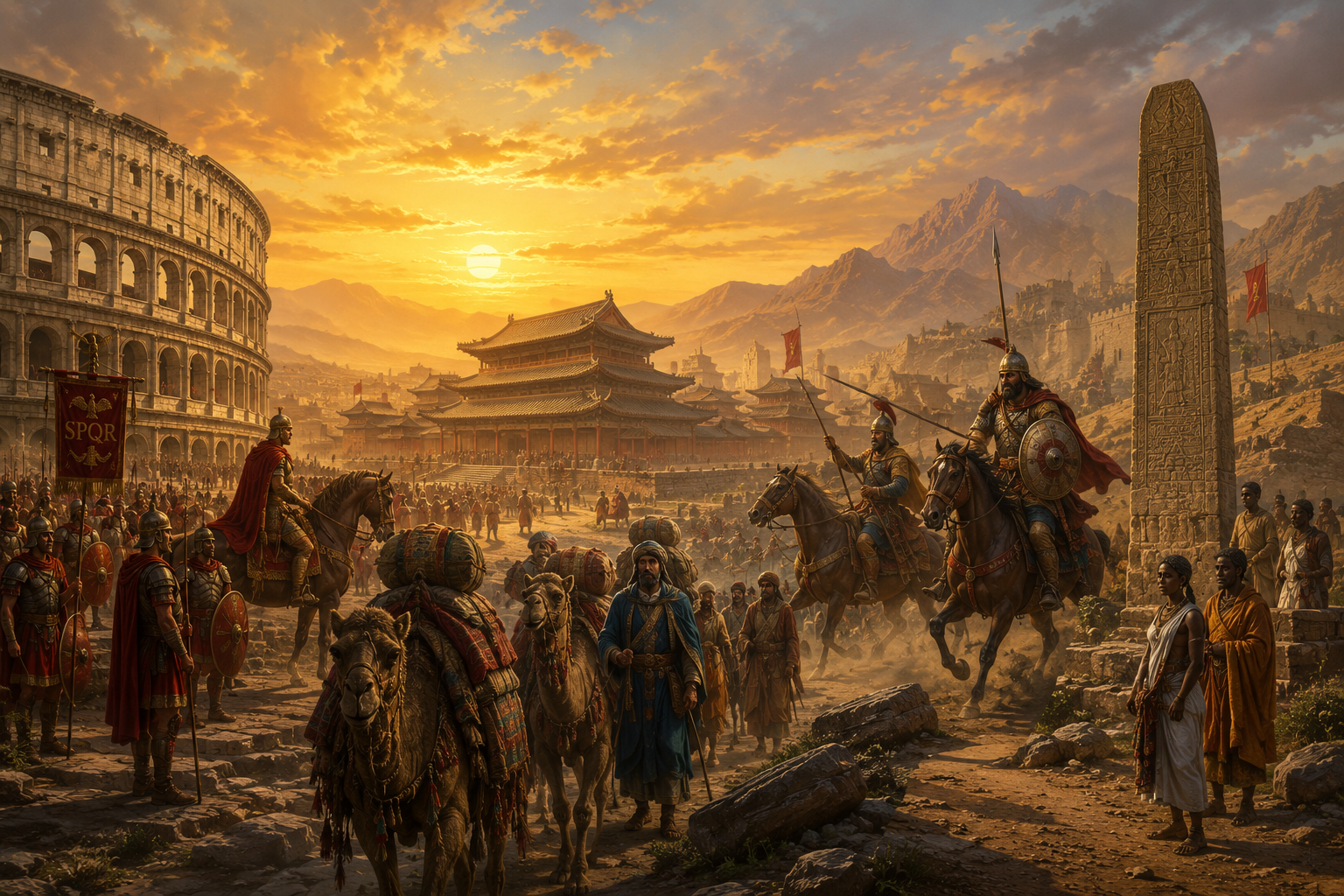
Explore the civilizations that flourished alongside Rome—and discover why viewing history on a global timeline changes everything.
The Roman Empire at Its Greatest
When people think of ancient history, the Roman Empire often comes to mind first. Between 27 BC and AD 180, during the period known as the Pax Romana (Roman Peace), Rome experienced nearly two centuries of remarkable stability, prosperity, and expansion.
Its vast network of roads connected thousands of miles of territory. Aqueducts supplied clean water to cities, magnificent temples and amphitheaters transformed the urban landscape, and trade flowed across the Mediterranean.
At its height, Rome governed millions of people from Britain in the northwest to Mesopotamia in the east. It became one of the most influential civilizations in human history.
But Rome wasn’t alone.
While Roman legions marched across Europe and the Mediterranean, other civilizations were also experiencing extraordinary moments of growth, innovation, and cultural achievement.
History becomes far more fascinating when viewed from a global perspective.

China: The Han Dynasty Was Entering Its Golden Age
While Rome ruled the Mediterranean, the Han Dynasty stood as the dominant power in East Asia.
The Han Empire expanded deep into Central Asia, securing important sections of the Silk Road and establishing long-distance trade routes that connected China with lands thousands of miles away.
This was also an age of remarkable innovation.
Papermaking was refined during the Eastern Han period, dramatically changing how knowledge could be preserved and shared. Astronomy, mathematics, metallurgy, and government administration all reached new levels of sophistication.
The imperial court promoted education and Confucian scholarship, laying foundations that would influence Chinese civilization for centuries.
Although separated by vast deserts and mountain ranges, Han China and Rome were indirectly connected through merchants carrying silk, spices, glassware, and precious metals across Eurasia.

The Kushan Empire Connected East and West
Between Rome and China stood one of history’s most overlooked civilizations—the Kushan Empire.
Stretching across modern Afghanistan, Pakistan, northern India, and parts of Central Asia, the Kushans occupied one of the world’s most strategic locations.
Rather than conquering vast territories like Rome, the Kushans became masters of commerce.
They controlled major crossroads along the Silk Road, allowing goods, technologies, religions, and artistic ideas to move between East and West.
The Kushans also played a critical role in spreading Buddhism throughout Central Asia and eventually into China.
Their cities blended Greek, Persian, Indian, and Central Asian influences, creating one of the ancient world’s richest cultural exchanges.
Without the Kushan Empire, the Silk Road would never have functioned quite the same way.

Rome’s Greatest Eastern Rival: The Parthian Empire
Rome dominated Europe and the Mediterranean—but its eastern frontier faced a formidable opponent.
The Parthian Empire controlled Persia and much of the Middle East, serving as Rome’s greatest geopolitical rival for centuries.
Unlike the disciplined Roman legions, the Parthians became famous for their highly mobile cavalry and deadly mounted archers.
The two empires repeatedly clashed over Armenia and Mesopotamia, yet they also depended upon one another for trade.
Silk from China, spices from India, precious gems, horses, and luxury goods all passed through Parthian territory before reaching Roman markets.
Competition and commerce existed side by side.
The ancient world was already deeply interconnected.

Africa Was Thriving Too
Ancient Africa was home to powerful civilizations that are often overlooked in traditional world history.
The Kingdom of Aksum
Located in present-day Ethiopia and Eritrea, the Kingdom of Aksum became one of the world’s great trading powers.
Its merchants sailed across the Red Sea and Indian Ocean, exporting ivory, gold, incense, and exotic goods while connecting Africa with Arabia, India, and the Mediterranean.
Aksum would later become one of the earliest Christian kingdoms in history.
The Kingdom of Kush (Meroë)
Further north, along the Nile River, the Kingdom of Kush continued to flourish.
Its capital at Meroë became famous for iron production, monumental architecture, and extensive trade with Roman Egypt.
Far from being isolated, northeastern Africa actively participated in the economic networks of the ancient world.

Across the Atlantic, Another Civilization Was Rising
While Rome reached its imperial peak, an extraordinary city was emerging in Mesoamerica.
Teotihuacan, located in present-day Mexico, grew into one of the largest urban centers in the world.
Its monumental Pyramid of the Sun, broad ceremonial avenues, and sophisticated urban planning demonstrated an advanced civilization developing entirely independently of Eurasia.
Unlike Rome or China, Teotihuacan had no contact with the Old World.
Yet its achievements remind us that human civilizations have repeatedly developed remarkable complexity in different parts of the globe.

Meanwhile, the Rest of the World Continued to Evolve
Not every society built vast empires.
Across North America, South America, Oceania, and many regions of Africa, diverse Indigenous cultures continued developing unique traditions, technologies, and social systems.
Some practiced agriculture.
Others maintained sophisticated hunter-gatherer societies perfectly adapted to their environments.
Each contributed to humanity’s shared story in different ways.
World history has never belonged to a single civilization.
Seeing History Side by Side Changes Everything
Most history books teach civilizations one chapter at a time.
First Egypt.
Then Greece.
Then Rome.
Then China.
But history didn’t happen sequentially.
It happened simultaneously.
While Roman engineers built aqueducts, Han scholars refined papermaking.
While Parthian horse archers challenged Roman armies, Kushan merchants connected continents through trade.
While Aksum prospered along the Red Sea, Teotihuacan raised enormous pyramids across the Atlantic.
Viewing these civilizations together transforms our understanding of history.
Instead of isolated stories, we begin to see one interconnected human journey unfolding across thousands of years.
Explore 5,000 Years of Civilization on One Timeline
That idea inspired us to create the Timeline of World History.
Rather than presenting civilizations separately, this visual timeline places 21 modern countries and regions onto a single chronological framework spanning 5,000 years.
It allows you to compare civilizations, discover surprising historical connections, and understand what was happening around the world at the same moment in time.
Whether you’re a history enthusiast, teacher, student, or lifelong learner, seeing history side by side offers a completely new perspective.
Explore the Timeline of World History: