 Over 150,000 satisfied customers
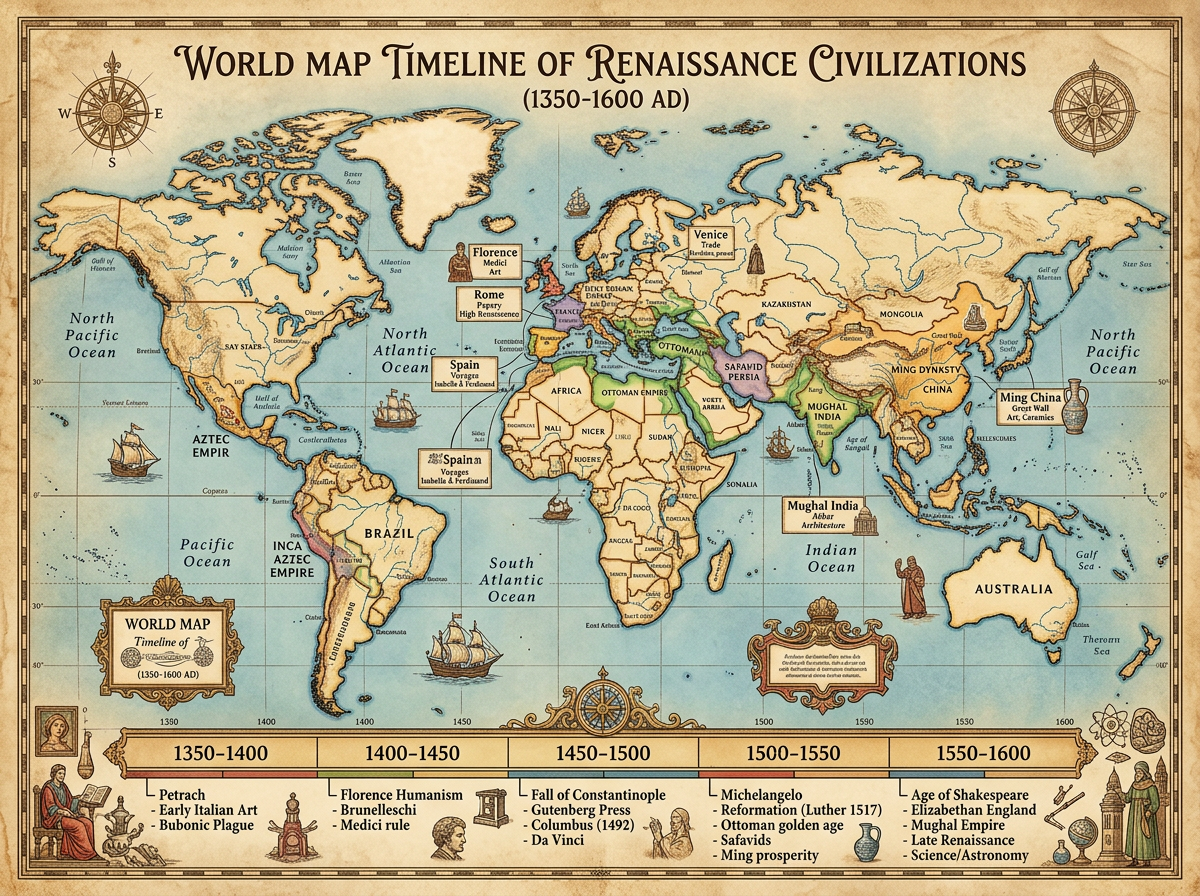
When people hear the word Renaissance, they often picture Leonardo da Vinci sketching inventions, Michelangelo painting the Sistine Chapel ceiling, or Florence flourishing as the center of European art and learning.
But while Europe was experiencing its Renaissance, the rest of the world was far from standing still.
Powerful empires were rising, global trade routes were expanding, remarkable works of architecture were being built, and scientific discoveries were transforming societies across Asia, Africa, and the Americas.
Looking at the Renaissance through a global lens reveals a fascinating truth:
History never happens in isolation.
When Was the Renaissance?
The European Renaissance is generally dated from the 14th to the 17th century, with its height occurring roughly between 1450 and 1600.
During this same period, civilizations around the world were experiencing their own golden ages, political transformations, and cultural achievements.
Europe: The Birth of a New Way of Thinking

Italy became the birthplace of the Renaissance, fueled by prosperous city-states such as Florence, Venice, and Milan.
Artists embraced realism and perspective.
Scientists questioned traditional ideas.
Scholars rediscovered ancient Greek and Roman texts.
The invention of Gutenberg’s printing press around 1450 accelerated the spread of knowledge across Europe, making books more accessible than ever before.
At the same time, European explorers were preparing voyages that would permanently reshape world history.
China: The Height of the Ming Dynasty

While Europe was rediscovering classical knowledge, China’s Ming Dynasty (1368–1644) was one of the world’s most advanced civilizations.
Highlights included:
- Construction and expansion of the Forbidden City
- Restoration of the Great Wall
- Massive maritime expeditions led by Zheng He
- Growth in porcelain production, literature, and printing
- Rapid urban and commercial development
Although China eventually reduced overseas exploration, its economy and craftsmanship continued to influence global trade for centuries.
The Ottoman Empire: A Bridge Between Continents

In 1453, Sultan Mehmed II captured Constantinople, marking the end of the Byzantine Empire.
The city became Istanbul, capital of the rapidly expanding Ottoman Empire.
Rather than simply conquering territory, the Ottomans transformed Istanbul into one of the world’s greatest cities, connecting Europe, Asia, and Africa through commerce and culture.
The empire became a major center for:
- Architecture
- Astronomy
- Medicine
- Mathematics
- International trade
Persia: The Rise of the Safavid Empire

Beginning in 1501, the Safavid Empire united much of Persia under a centralized government.
Its capital, Isfahan, became famous for magnificent mosques, gardens, bridges, and marketplaces.
Safavid artists produced intricate carpets, ceramics, and miniature paintings that are still admired today.
Persia also occupied a strategic position between Europe, India, and Central Asia, making it a key player in international commerce.
India: The Splendor of the Mughal Empire

The Mughal Empire, founded in 1526, blended Persian, Central Asian, and Indian traditions into one of history’s richest cultural civilizations.
Under rulers such as Akbar, the empire encouraged:
- Religious dialogue
- Administrative reform
- Literature
- Art
- Monumental architecture
Although the Taj Mahal would not be completed until the following century, the artistic foundations of Mughal architecture were established during the Renaissance era.
Japan: The Age of Warring States

While Europe enjoyed cultural revival, Japan experienced the turbulent Sengoku Period.
Regional lords competed for power, leading to nearly constant warfare.
Yet this period also stimulated:
- Castle construction
- Military innovation
- Urban development
- Artistic refinement
Near the end of the sixteenth century, leaders such as Oda Nobunaga and Toyotomi Hideyoshi began laying the foundations for Japan’s eventual unification.
Africa: Powerful Kingdoms and Global Trade

Africa during the Renaissance was home to numerous thriving states.
Among them:
Ethiopia
The Ethiopian Empire maintained ancient Christian traditions while strengthening diplomatic and commercial ties with Europe and the Middle East.
Songhai Empire
Centered in West Africa, the Songhai Empire became one of the largest states in African history.
Cities such as Timbuktu attracted scholars from across the Islamic world, making the region an important center of learning.
Meanwhile, trade across the Sahara transported:
- Gold
- Salt
- Textiles
- Books
- Ideas
The Americas Before European Colonization

Before large-scale European colonization, sophisticated civilizations flourished across the Americas.
The Aztec Empire
Centered on Tenochtitlan, one of the world’s largest cities at the time, the Aztecs developed impressive engineering, agriculture, and monumental architecture.
The Inca Empire
Stretching along the Andes, the Incas built thousands of kilometers of roads connecting mountains, valleys, and cities.
Without wheeled transport or iron tools, they constructed engineering works that continue to astonish historians today.
A World Becoming Connected
One of the most important developments of the Renaissance was not confined to Europe.
It was the gradual emergence of a truly interconnected world.
Portuguese sailors rounded Africa.
Spanish expeditions crossed the Atlantic.
Trade expanded across the Indian Ocean.
Silk, spices, silver, porcelain, textiles, and new crops traveled between continents at unprecedented scales.
Ideas spread alongside goods.
By the early seventeenth century, civilizations that had developed largely independently for thousands of years were becoming increasingly linked through exploration, commerce, diplomacy, and conflict.
Seeing the Renaissance from a Global Perspective
The Renaissance was never only a European story.
While artists painted masterpieces in Florence, the Ming Dynasty governed one of the world’s largest economies.
While Michelangelo sculpted marble, Ottoman architects transformed Istanbul.
While European printers published books, scholars in Timbuktu copied manuscripts, Mughal emperors built magnificent capitals, and Aztec engineers expanded one of the greatest cities in the Americas.
History becomes far richer when we stop viewing civilizations separately and begin seeing them together.
That is exactly the perspective our Timeline of World History is designed to provide—placing civilizations from 21 modern countries onto a single timeline so you can explore what was happening around the world at the same moment in history.
Because every civilization has its own story.
Together, they tell the story of humanity.
Explore the Timeline of World History: