Category: Parallel History

  • Roman Empire vs Han Dynasty: Two Superpowers That Ruled the Ancient World

    Roman Empire vs Han Dynasty: Two Superpowers That Ruled the Ancient World

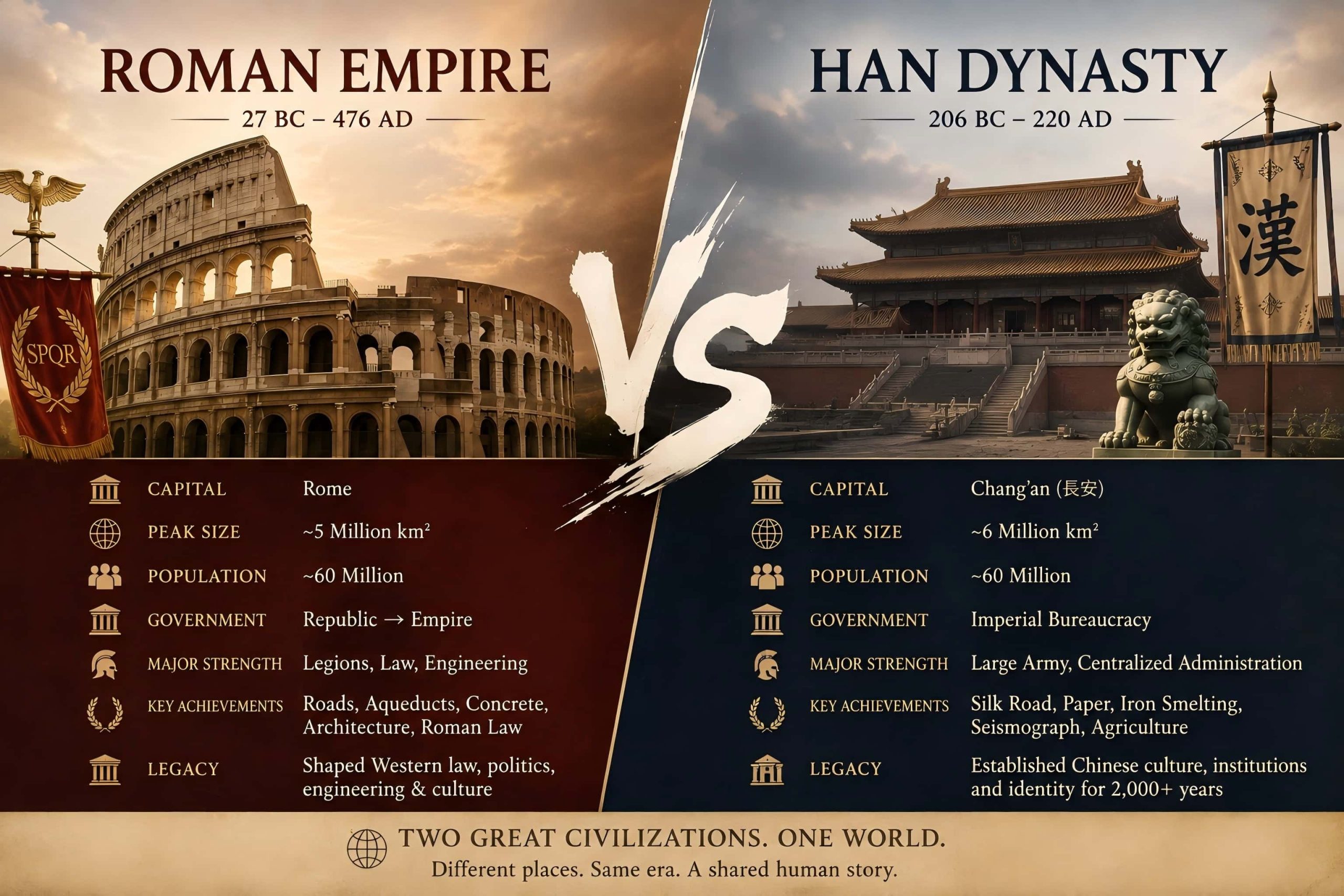
    What was happening on opposite sides of Eurasia when Rome ruled the Mediterranean? While emperors governed from Rome, another great empire—the Han Dynasty—was flourishing in East Asia. Although separated by thousands of miles, these two civilizations developed remarkably similar systems of government, trade, engineering, and culture.


    Introduction

    When people think of the ancient world, they often picture the Roman Empire. Images of the Colosseum, Roman roads, and disciplined legions have become symbols of classical civilization.

    Yet while Rome dominated Europe and the Mediterranean, another civilization was reaching its own golden age in East Asia—the Han Dynasty.

    The Roman Empire and the Han Dynasty were the two largest and most influential powers of the first centuries AD. Although they never fought each other and likely never met face to face, they developed in parallel, each shaping the future of its own half of the world.

    Comparing these two civilizations reveals just how interconnected—and surprisingly similar—the ancient world really was.


    Two Empires at Their Peak

    At roughly the same time, both empires controlled enormous territories.

    The Roman Empire reached its greatest stability during the Pax Romana (27 BC–AD 180), when peace, trade, and prosperity spread across much of Europe, North Africa, and the Middle East.

    Meanwhile, the Han Dynasty (206 BC–AD 220) unified China after centuries of conflict and established one of the strongest centralized governments in Chinese history.

    Both ruled populations of roughly 60 million people, making them among the largest political entities on Earth.


    roman-empire-timeline

    Government and Administration

    Despite their different cultures, both empires understood that governing millions of people required an efficient bureaucracy.

    Roman Empire

    Rome divided its territory into provinces governed by officials appointed by the emperor. Roman law became the foundation of administration, taxation, and justice throughout the empire.

    An extensive road network allowed officials, merchants, and soldiers to travel quickly across thousands of kilometers.

    Han Dynasty

    The Han Dynasty built a highly centralized government based on Confucian ideals.

    Officials were selected for their education and administrative ability rather than noble birth alone. Local governors reported directly to the imperial court, allowing the emperor to maintain control over distant provinces.

    This administrative model would influence Chinese government for nearly two thousand years.


    Military Power

    Neither empire became powerful by accident.

    Roman expansion relied on its famous legions, whose discipline and organization allowed Rome to conquer vast territories around the Mediterranean.

    The Han Dynasty faced different challenges. Rather than expanding westward indefinitely, it spent much of its history defending China’s northern frontier against nomadic confederations such as the Xiongnu. Massive armies, cavalry units, and early sections of the Great Wall helped secure the empire.

    Both civilizations invested heavily in infrastructure that supported their military, from roads in Rome to frontier fortifications in Han China.


    Economy and Trade

    Trade played a crucial role in both empires.

    The Romans exported:

    • Wine
    • Olive oil
    • Glassware
    • Metal goods

    The Han Dynasty became famous for:

    • Silk
    • Iron tools
    • Ceramics
    • Lacquerware
    • Paper

    Although separated by deserts and mountains, their economies became loosely connected through the Silk Road.

    Chinese silk became one of the most prized luxury goods in Rome. Roman coins have even been discovered in parts of China, while Chinese historical records mention a distant western empire known as Daqin, believed to refer to Rome.


    Science and Engineering

    Both civilizations produced remarkable technological achievements.

    Roman Innovations

    • Concrete construction
    • Aqueducts
    • Public baths
    • Multi-story architecture
    • Roads stretching over 80,000 km

    Roman engineering emphasized durability and public infrastructure.

    Han Innovations

    The Han Dynasty produced inventions that would transform world history.

    Among them were:

    • Paper
    • The wheelbarrow
    • Advanced iron casting
    • The world’s first seismograph
    • Improved agricultural techniques

    Many of these inventions spread gradually across Asia and eventually reached Europe centuries later.


    Daily Life

    Despite their similarities in size and power, everyday life looked quite different.

    Roman cities featured forums, amphitheaters, baths, and bustling marketplaces where citizens gathered for commerce and entertainment.

    Han Chinese cities centered around administrative complexes, markets, workshops, and Confucian institutions.

    Education also differed.

    Roman education focused heavily on rhetoric, philosophy, and public speaking, while Han scholars devoted themselves to Confucian classics that emphasized morality and effective government.


    Religion and Culture

    Religion reflected the diversity of both civilizations.

    Romans worshipped a wide pantheon of gods before Christianity gradually spread throughout the empire.

    The Han Dynasty blended Confucianism with Daoist philosophy and local religious traditions. During the later Han period, Buddhism also began entering China through the Silk Road.

    Although their beliefs differed, both civilizations left lasting cultural traditions that continue to influence millions of people today.


    Legacy

    The Roman Empire laid the foundations for much of modern Europe.

    Its legal principles, engineering, architecture, and political ideas continue to shape Western civilization.

    The Han Dynasty established many of the institutions that still define Chinese culture today. Even now, China’s majority ethnic group refers to itself as the Han people.

    Few civilizations have had such enduring influence.


    Conclusion

    The Roman Empire and the Han Dynasty never met as rivals, yet together they defined the ancient world.

    One dominated the Mediterranean. The other unified East Asia.

    Looking at them side by side reminds us that history isn’t a single timeline centered on one civilization. Great societies often rise simultaneously, each contributing to humanity in different ways.

    That’s exactly why comparing civilizations across time is so fascinating—and why viewing history on a single parallel timeline offers an entirely new perspective on our shared past.


    Further Reading

    If you’d like to see where Rome and the Han Dynasty fit into the broader story of world history, explore our 5,000-Year World History Timeline, where 21 civilizations unfold side by side across one continuous visual map.
  • What Happened Around the World During the Renaissance?

    What Happened Around the World During the Renaissance?

    When people hear the word Renaissance, they often picture Leonardo da Vinci sketching inventions, Michelangelo painting the Sistine Chapel ceiling, or Florence flourishing as the center of European art and learning.

    But while Europe was experiencing its Renaissance, the rest of the world was far from standing still.

    Powerful empires were rising, global trade routes were expanding, remarkable works of architecture were being built, and scientific discoveries were transforming societies across Asia, Africa, and the Americas.

    Looking at the Renaissance through a global lens reveals a fascinating truth:

    History never happens in isolation.


    When Was the Renaissance?

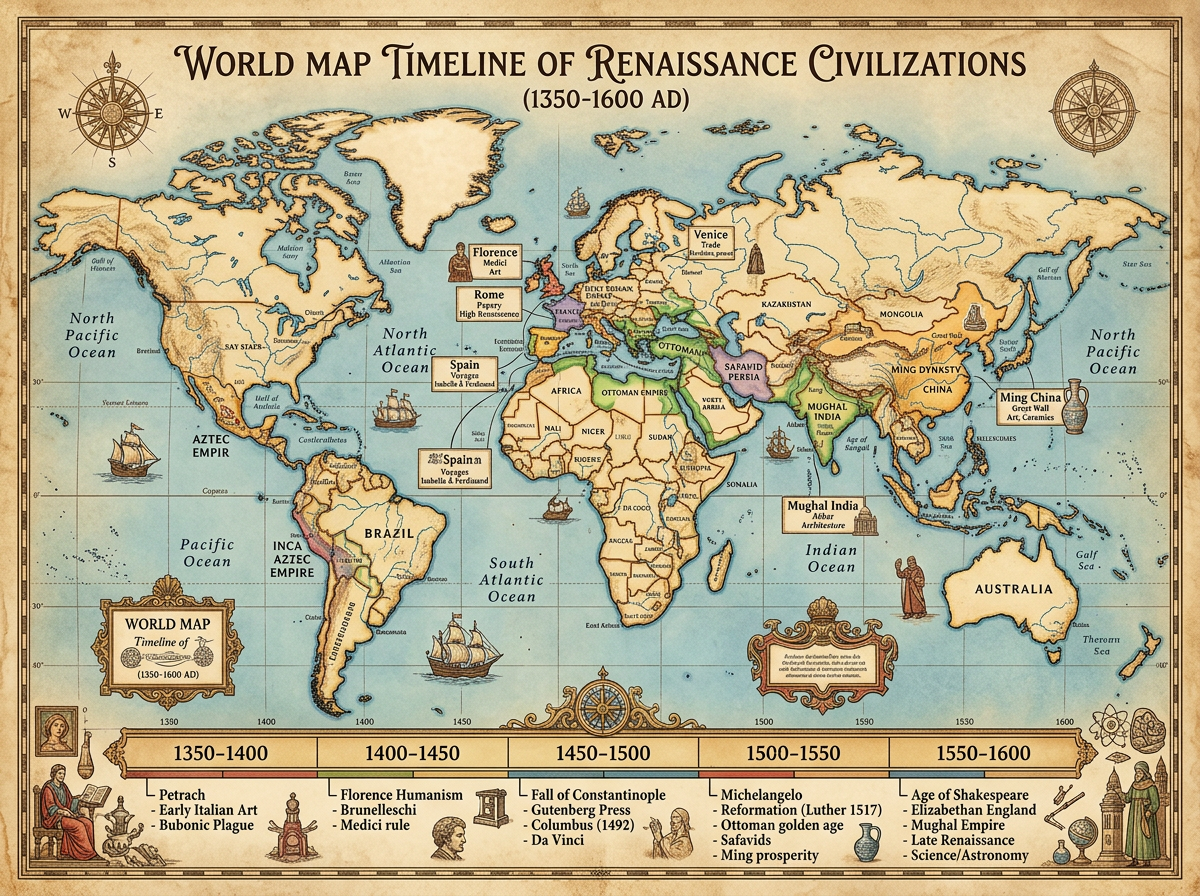
    The European Renaissance is generally dated from the 14th to the 17th century, with its height occurring roughly between 1450 and 1600.

    During this same period, civilizations around the world were experiencing their own golden ages, political transformations, and cultural achievements.


    Europe: The Birth of a New Way of Thinking

    Three Renaissance men sketching with Florence cityscape and cathedral dome behind them

    Italy became the birthplace of the Renaissance, fueled by prosperous city-states such as Florence, Venice, and Milan.

    Artists embraced realism and perspective.

    Scientists questioned traditional ideas.

    Scholars rediscovered ancient Greek and Roman texts.

    The invention of Gutenberg’s printing press around 1450 accelerated the spread of knowledge across Europe, making books more accessible than ever before.

    At the same time, European explorers were preparing voyages that would permanently reshape world history.


    China: The Height of the Ming Dynasty

    Large traditional Chinese wooden sailing ships with multiple sails in a harbor with historic buildings and many people

    While Europe was rediscovering classical knowledge, China’s Ming Dynasty (1368–1644) was one of the world’s most advanced civilizations.

    Highlights included:

    • Construction and expansion of the Forbidden City
    • Restoration of the Great Wall
    • Massive maritime expeditions led by Zheng He
    • Growth in porcelain production, literature, and printing
    • Rapid urban and commercial development

    Although China eventually reduced overseas exploration, its economy and craftsmanship continued to influence global trade for centuries.


    The Ottoman Empire: A Bridge Between Continents

    Istanbul skyline at sunset with Hagia Sophia and other mosques lit up near the Bosphorus Strait

    In 1453, Sultan Mehmed II captured Constantinople, marking the end of the Byzantine Empire.

    The city became Istanbul, capital of the rapidly expanding Ottoman Empire.

    Rather than simply conquering territory, the Ottomans transformed Istanbul into one of the world’s greatest cities, connecting Europe, Asia, and Africa through commerce and culture.

    The empire became a major center for:

    • Architecture
    • Astronomy
    • Medicine
    • Mathematics
    • International trade

    Persia: The Rise of the Safavid Empire

    Aerial view of Naghsh-e Jahan Square with traditional buildings, mosque domes, gardens, and fountain

    Beginning in 1501, the Safavid Empire united much of Persia under a centralized government.

    Its capital, Isfahan, became famous for magnificent mosques, gardens, bridges, and marketplaces.

    Safavid artists produced intricate carpets, ceramics, and miniature paintings that are still admired today.

    Persia also occupied a strategic position between Europe, India, and Central Asia, making it a key player in international commerce.


    India: The Splendor of the Mughal Empire

    Mughal-style red sandstone buildings and garden with reflecting pool and people

    The Mughal Empire, founded in 1526, blended Persian, Central Asian, and Indian traditions into one of history’s richest cultural civilizations.

    Under rulers such as Akbar, the empire encouraged:

    • Religious dialogue
    • Administrative reform
    • Literature
    • Art
    • Monumental architecture

    Although the Taj Mahal would not be completed until the following century, the artistic foundations of Mughal architecture were established during the Renaissance era.


    Japan: The Age of Warring States

    Samurai in traditional armor holding a spear and sword in front of a Japanese castle during sunset

    While Europe enjoyed cultural revival, Japan experienced the turbulent Sengoku Period.

    Regional lords competed for power, leading to nearly constant warfare.

    Yet this period also stimulated:

    • Castle construction
    • Military innovation
    • Urban development
    • Artistic refinement

    Near the end of the sixteenth century, leaders such as Oda Nobunaga and Toyotomi Hideyoshi began laying the foundations for Japan’s eventual unification.


    Africa: Powerful Kingdoms and Global Trade

    Circular stone ruins with a conical tower and visitors walking nearby at sunset

    Africa during the Renaissance was home to numerous thriving states.

    Among them:

    Ethiopia

    The Ethiopian Empire maintained ancient Christian traditions while strengthening diplomatic and commercial ties with Europe and the Middle East.

    Songhai Empire

    Centered in West Africa, the Songhai Empire became one of the largest states in African history.

    Cities such as Timbuktu attracted scholars from across the Islamic world, making the region an important center of learning.

    Meanwhile, trade across the Sahara transported:

    • Gold
    • Salt
    • Textiles
    • Books
    • Ideas

    The Americas Before European Colonization

    Before large-scale European colonization, sophisticated civilizations flourished across the Americas.

    The Aztec Empire

    Centered on Tenochtitlan, one of the world’s largest cities at the time, the Aztecs developed impressive engineering, agriculture, and monumental architecture.

    The Inca Empire

    Stretching along the Andes, the Incas built thousands of kilometers of roads connecting mountains, valleys, and cities.

    Without wheeled transport or iron tools, they constructed engineering works that continue to astonish historians today.


    A World Becoming Connected

    One of the most important developments of the Renaissance was not confined to Europe.

    It was the gradual emergence of a truly interconnected world.

    Portuguese sailors rounded Africa.

    Spanish expeditions crossed the Atlantic.

    Trade expanded across the Indian Ocean.

    Silk, spices, silver, porcelain, textiles, and new crops traveled between continents at unprecedented scales.

    Ideas spread alongside goods.

    By the early seventeenth century, civilizations that had developed largely independently for thousands of years were becoming increasingly linked through exploration, commerce, diplomacy, and conflict.


    Seeing the Renaissance from a Global Perspective

    The Renaissance was never only a European story.

    While artists painted masterpieces in Florence, the Ming Dynasty governed one of the world’s largest economies.

    While Michelangelo sculpted marble, Ottoman architects transformed Istanbul.

    While European printers published books, scholars in Timbuktu copied manuscripts, Mughal emperors built magnificent capitals, and Aztec engineers expanded one of the greatest cities in the Americas.

    History becomes far richer when we stop viewing civilizations separately and begin seeing them together.

    That is exactly the perspective our Timeline of World History is designed to provide—placing civilizations from 21 modern countries onto a single timeline so you can explore what was happening around the world at the same moment in history.

    Because every civilization has its own story.

    Together, they tell the story of humanity.

    Explore the Timeline of World History:

  • What Was Happening Around the World During the Height of the Roman Empire?

    What Was Happening Around the World During the Height of the Roman Empire?

    Explore the civilizations that flourished alongside Rome—and discover why viewing history on a global timeline changes everything.


    The Roman Empire at Its Greatest

    When people think of ancient history, the Roman Empire often comes to mind first. Between 27 BC and AD 180, during the period known as the Pax Romana (Roman Peace), Rome experienced nearly two centuries of remarkable stability, prosperity, and expansion.

    Its vast network of roads connected thousands of miles of territory. Aqueducts supplied clean water to cities, magnificent temples and amphitheaters transformed the urban landscape, and trade flowed across the Mediterranean.

    At its height, Rome governed millions of people from Britain in the northwest to Mesopotamia in the east. It became one of the most influential civilizations in human history.

    But Rome wasn’t alone.

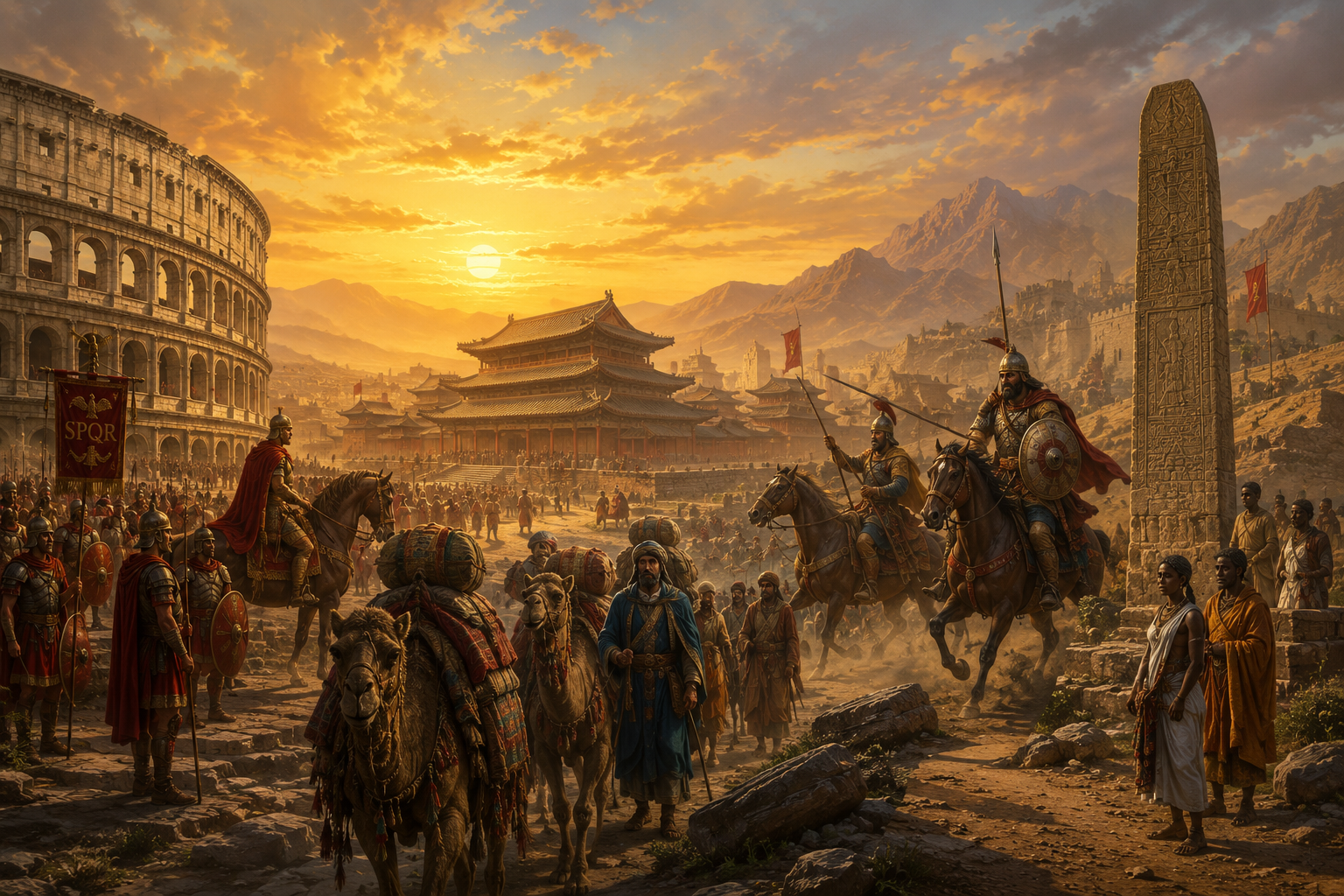
    While Roman legions marched across Europe and the Mediterranean, other civilizations were also experiencing extraordinary moments of growth, innovation, and cultural achievement.

    History becomes far more fascinating when viewed from a global perspective.


    roman-empire-timeline

    China: The Han Dynasty Was Entering Its Golden Age

    While Rome ruled the Mediterranean, the Han Dynasty stood as the dominant power in East Asia.

    The Han Empire expanded deep into Central Asia, securing important sections of the Silk Road and establishing long-distance trade routes that connected China with lands thousands of miles away.

    This was also an age of remarkable innovation.

    Papermaking was refined during the Eastern Han period, dramatically changing how knowledge could be preserved and shared. Astronomy, mathematics, metallurgy, and government administration all reached new levels of sophistication.

    The imperial court promoted education and Confucian scholarship, laying foundations that would influence Chinese civilization for centuries.

    Although separated by vast deserts and mountain ranges, Han China and Rome were indirectly connected through merchants carrying silk, spices, glassware, and precious metals across Eurasia.


    The Kushan Empire Connected East and West

    Between Rome and China stood one of history’s most overlooked civilizations—the Kushan Empire.

    Stretching across modern Afghanistan, Pakistan, northern India, and parts of Central Asia, the Kushans occupied one of the world’s most strategic locations.

    Rather than conquering vast territories like Rome, the Kushans became masters of commerce.

    They controlled major crossroads along the Silk Road, allowing goods, technologies, religions, and artistic ideas to move between East and West.

    The Kushans also played a critical role in spreading Buddhism throughout Central Asia and eventually into China.

    Their cities blended Greek, Persian, Indian, and Central Asian influences, creating one of the ancient world’s richest cultural exchanges.

    Without the Kushan Empire, the Silk Road would never have functioned quite the same way.


    Rome’s Greatest Eastern Rival: The Parthian Empire

    Rome dominated Europe and the Mediterranean—but its eastern frontier faced a formidable opponent.

    The Parthian Empire controlled Persia and much of the Middle East, serving as Rome’s greatest geopolitical rival for centuries.

    Unlike the disciplined Roman legions, the Parthians became famous for their highly mobile cavalry and deadly mounted archers.

    The two empires repeatedly clashed over Armenia and Mesopotamia, yet they also depended upon one another for trade.

    Silk from China, spices from India, precious gems, horses, and luxury goods all passed through Parthian territory before reaching Roman markets.

    Competition and commerce existed side by side.

    The ancient world was already deeply interconnected.


    Africa Was Thriving Too

    Ancient Africa was home to powerful civilizations that are often overlooked in traditional world history.

    The Kingdom of Aksum

    Located in present-day Ethiopia and Eritrea, the Kingdom of Aksum became one of the world’s great trading powers.

    Its merchants sailed across the Red Sea and Indian Ocean, exporting ivory, gold, incense, and exotic goods while connecting Africa with Arabia, India, and the Mediterranean.

    Aksum would later become one of the earliest Christian kingdoms in history.

    The Kingdom of Kush (Meroë)

    Further north, along the Nile River, the Kingdom of Kush continued to flourish.

    Its capital at Meroë became famous for iron production, monumental architecture, and extensive trade with Roman Egypt.

    Far from being isolated, northeastern Africa actively participated in the economic networks of the ancient world.


    Across the Atlantic, Another Civilization Was Rising

    While Rome reached its imperial peak, an extraordinary city was emerging in Mesoamerica.

    Teotihuacan, located in present-day Mexico, grew into one of the largest urban centers in the world.

    Its monumental Pyramid of the Sun, broad ceremonial avenues, and sophisticated urban planning demonstrated an advanced civilization developing entirely independently of Eurasia.

    Unlike Rome or China, Teotihuacan had no contact with the Old World.

    Yet its achievements remind us that human civilizations have repeatedly developed remarkable complexity in different parts of the globe.


    Meanwhile, the Rest of the World Continued to Evolve

    Not every society built vast empires.

    Across North America, South America, Oceania, and many regions of Africa, diverse Indigenous cultures continued developing unique traditions, technologies, and social systems.

    Some practiced agriculture.

    Others maintained sophisticated hunter-gatherer societies perfectly adapted to their environments.

    Each contributed to humanity’s shared story in different ways.

    World history has never belonged to a single civilization.


    Seeing History Side by Side Changes Everything

    Most history books teach civilizations one chapter at a time.

    First Egypt.

    Then Greece.

    Then Rome.

    Then China.

    But history didn’t happen sequentially.

    It happened simultaneously.

    While Roman engineers built aqueducts, Han scholars refined papermaking.

    While Parthian horse archers challenged Roman armies, Kushan merchants connected continents through trade.

    While Aksum prospered along the Red Sea, Teotihuacan raised enormous pyramids across the Atlantic.

    Viewing these civilizations together transforms our understanding of history.

    Instead of isolated stories, we begin to see one interconnected human journey unfolding across thousands of years.


    Explore 5,000 Years of Civilization on One Timeline

    That idea inspired us to create the Timeline of World History.

    Rather than presenting civilizations separately, this visual timeline places 21 modern countries and regions onto a single chronological framework spanning 5,000 years.

    It allows you to compare civilizations, discover surprising historical connections, and understand what was happening around the world at the same moment in time.

    Whether you’re a history enthusiast, teacher, student, or lifelong learner, seeing history side by side offers a completely new perspective.

    Explore the Timeline of World History: