 Over 150,000 satisfied customers
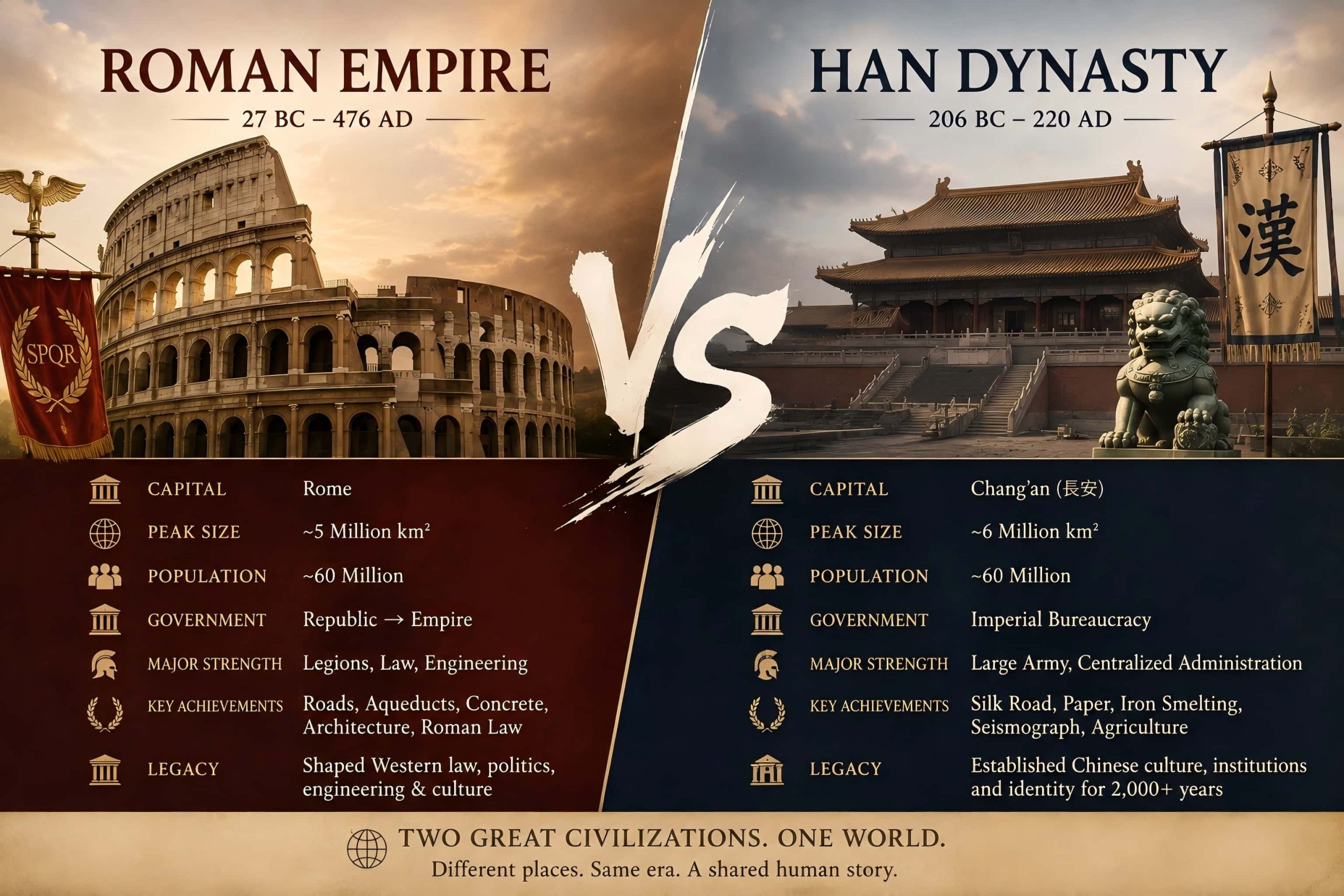
What was happening on opposite sides of Eurasia when Rome ruled the Mediterranean? While emperors governed from Rome, another great empire—the Han Dynasty—was flourishing in East Asia. Although separated by thousands of miles, these two civilizations developed remarkably similar systems of government, trade, engineering, and culture.
Introduction
When people think of the ancient world, they often picture the Roman Empire. Images of the Colosseum, Roman roads, and disciplined legions have become symbols of classical civilization.
Yet while Rome dominated Europe and the Mediterranean, another civilization was reaching its own golden age in East Asia—the Han Dynasty.
The Roman Empire and the Han Dynasty were the two largest and most influential powers of the first centuries AD. Although they never fought each other and likely never met face to face, they developed in parallel, each shaping the future of its own half of the world.
Comparing these two civilizations reveals just how interconnected—and surprisingly similar—the ancient world really was.
Two Empires at Their Peak
At roughly the same time, both empires controlled enormous territories.
The Roman Empire reached its greatest stability during the Pax Romana (27 BC–AD 180), when peace, trade, and prosperity spread across much of Europe, North Africa, and the Middle East.
Meanwhile, the Han Dynasty (206 BC–AD 220) unified China after centuries of conflict and established one of the strongest centralized governments in Chinese history.
Both ruled populations of roughly 60 million people, making them among the largest political entities on Earth.

Government and Administration
Despite their different cultures, both empires understood that governing millions of people required an efficient bureaucracy.
Roman Empire
Rome divided its territory into provinces governed by officials appointed by the emperor. Roman law became the foundation of administration, taxation, and justice throughout the empire.
An extensive road network allowed officials, merchants, and soldiers to travel quickly across thousands of kilometers.
Han Dynasty
The Han Dynasty built a highly centralized government based on Confucian ideals.
Officials were selected for their education and administrative ability rather than noble birth alone. Local governors reported directly to the imperial court, allowing the emperor to maintain control over distant provinces.
This administrative model would influence Chinese government for nearly two thousand years.
Military Power
Neither empire became powerful by accident.
Roman expansion relied on its famous legions, whose discipline and organization allowed Rome to conquer vast territories around the Mediterranean.
The Han Dynasty faced different challenges. Rather than expanding westward indefinitely, it spent much of its history defending China’s northern frontier against nomadic confederations such as the Xiongnu. Massive armies, cavalry units, and early sections of the Great Wall helped secure the empire.
Both civilizations invested heavily in infrastructure that supported their military, from roads in Rome to frontier fortifications in Han China.
Economy and Trade
Trade played a crucial role in both empires.
The Romans exported:
- Wine
- Olive oil
- Glassware
- Metal goods
The Han Dynasty became famous for:
- Silk
- Iron tools
- Ceramics
- Lacquerware
- Paper
Although separated by deserts and mountains, their economies became loosely connected through the Silk Road.
Chinese silk became one of the most prized luxury goods in Rome. Roman coins have even been discovered in parts of China, while Chinese historical records mention a distant western empire known as Daqin, believed to refer to Rome.

Science and Engineering
Both civilizations produced remarkable technological achievements.
Roman Innovations
- Concrete construction
- Aqueducts
- Public baths
- Multi-story architecture
- Roads stretching over 80,000 km
Roman engineering emphasized durability and public infrastructure.
Han Innovations
The Han Dynasty produced inventions that would transform world history.
Among them were:
- Paper
- The wheelbarrow
- Advanced iron casting
- The world’s first seismograph
- Improved agricultural techniques
Many of these inventions spread gradually across Asia and eventually reached Europe centuries later.
Daily Life
Despite their similarities in size and power, everyday life looked quite different.
Roman cities featured forums, amphitheaters, baths, and bustling marketplaces where citizens gathered for commerce and entertainment.
Han Chinese cities centered around administrative complexes, markets, workshops, and Confucian institutions.
Education also differed.
Roman education focused heavily on rhetoric, philosophy, and public speaking, while Han scholars devoted themselves to Confucian classics that emphasized morality and effective government.
Religion and Culture
Religion reflected the diversity of both civilizations.
Romans worshipped a wide pantheon of gods before Christianity gradually spread throughout the empire.
The Han Dynasty blended Confucianism with Daoist philosophy and local religious traditions. During the later Han period, Buddhism also began entering China through the Silk Road.
Although their beliefs differed, both civilizations left lasting cultural traditions that continue to influence millions of people today.
Legacy
The Roman Empire laid the foundations for much of modern Europe.
Its legal principles, engineering, architecture, and political ideas continue to shape Western civilization.
The Han Dynasty established many of the institutions that still define Chinese culture today. Even now, China’s majority ethnic group refers to itself as the Han people.
Few civilizations have had such enduring influence.
Conclusion
The Roman Empire and the Han Dynasty never met as rivals, yet together they defined the ancient world.
One dominated the Mediterranean. The other unified East Asia.
Looking at them side by side reminds us that history isn’t a single timeline centered on one civilization. Great societies often rise simultaneously, each contributing to humanity in different ways.
That’s exactly why comparing civilizations across time is so fascinating—and why viewing history on a single parallel timeline offers an entirely new perspective on our shared past.
Further Reading
If you’d like to see where Rome and the Han Dynasty fit into the broader story of world history, explore our 5,000-Year World History Timeline, where 21 civilizations unfold side by side across one continuous visual map.